
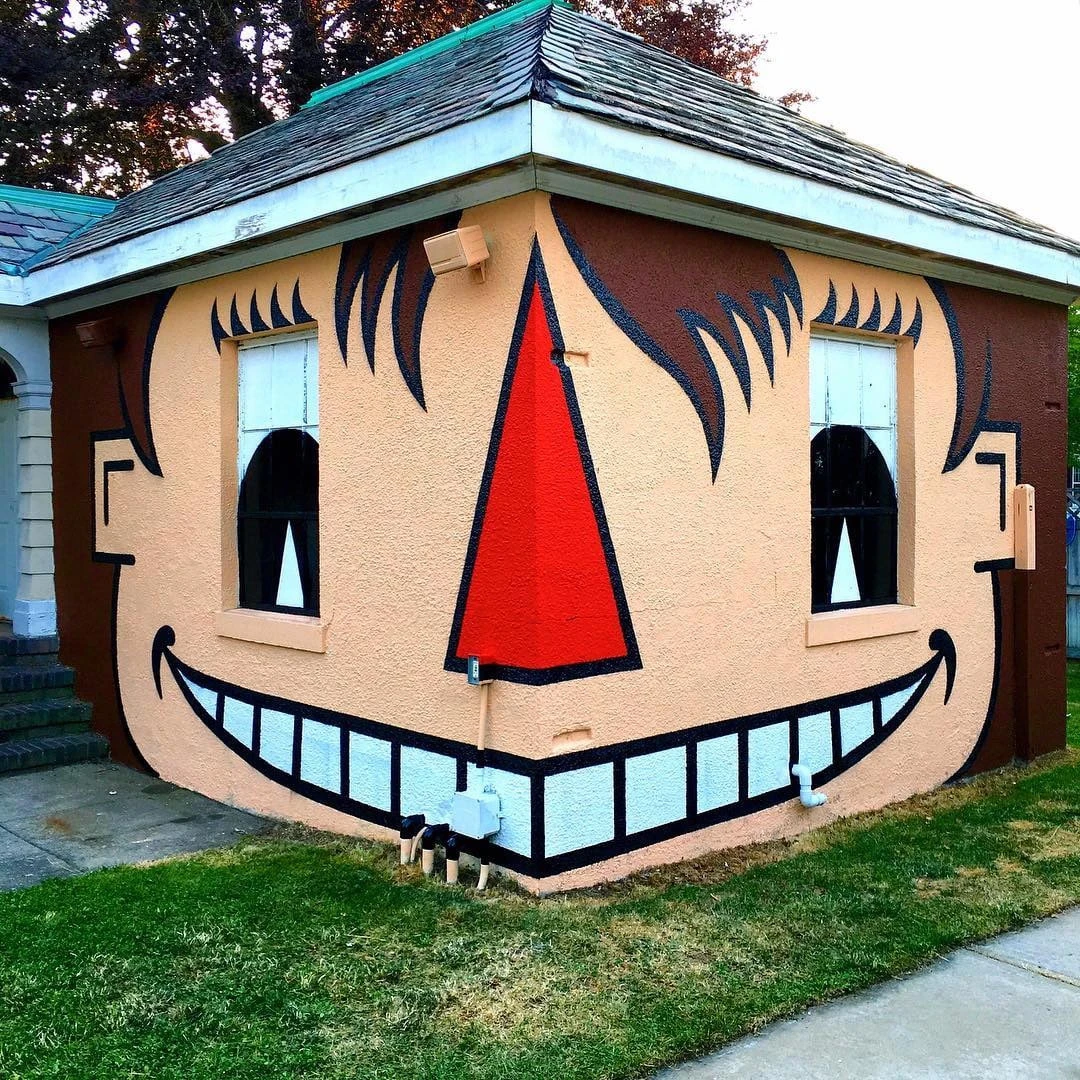
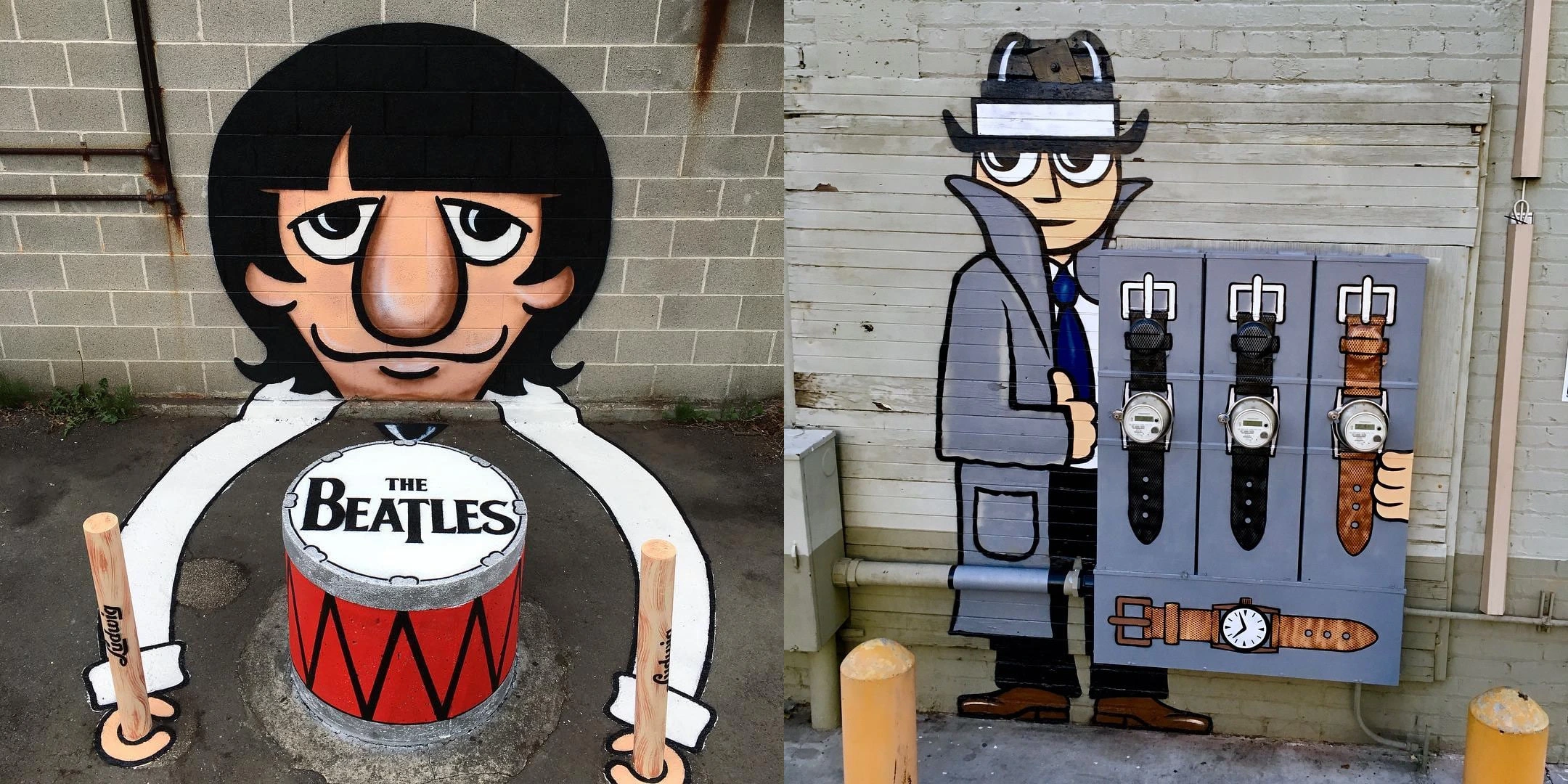
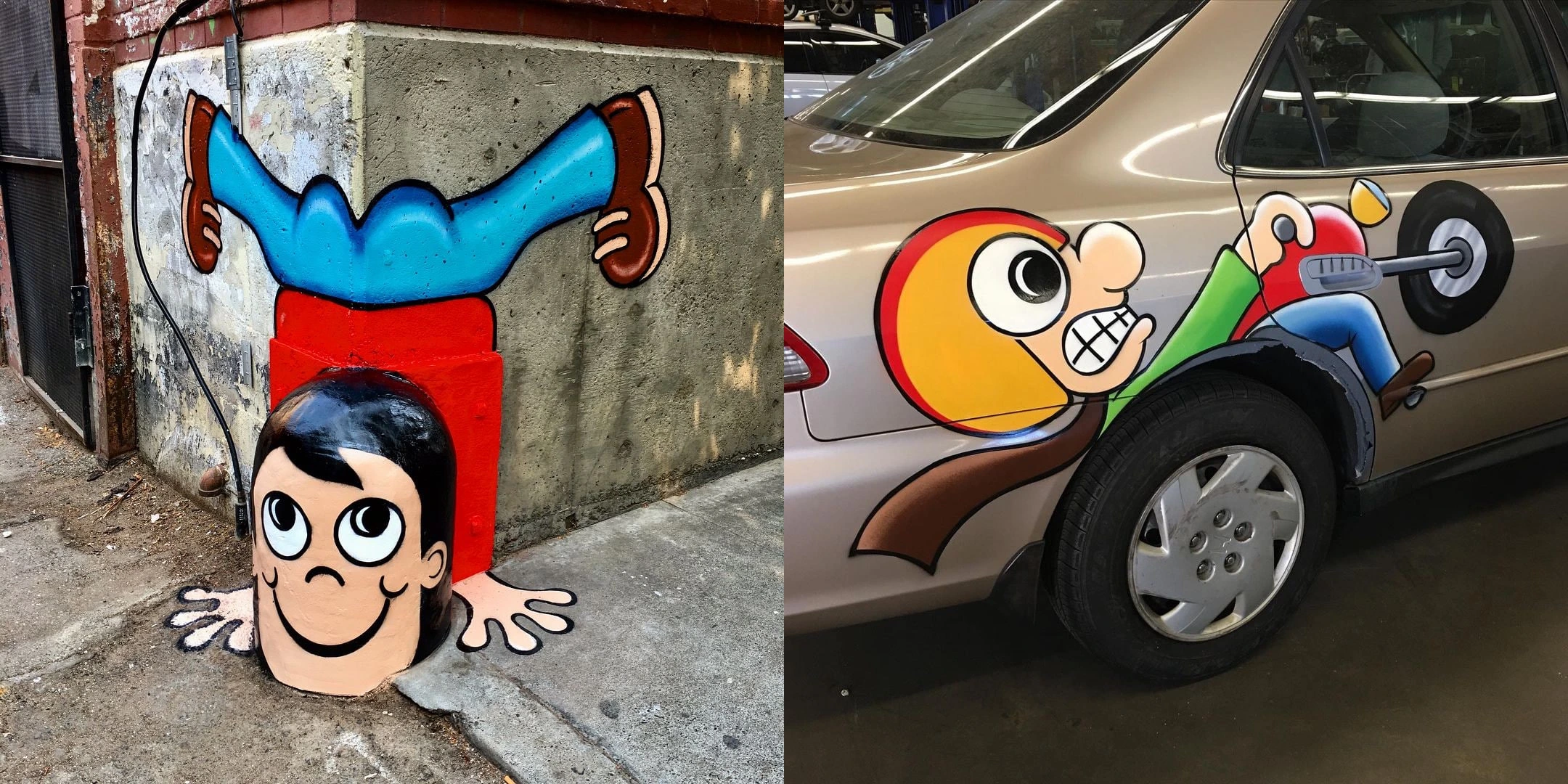
A drainpipe becomes an anteater’s nose, utility meters turn into watches inside a street seller’s coat, and the corner of a small building becomes an enormous smiling face. Tom Bob finds characters where most of us see ordinary infrastructure. His starting point is not a blank canvas, but the shape of something already there.
The object suggests the story
The New York street artist incorporates protrusions, bends, openings and real volume into his images. His characters are physically tied to their surroundings: a pipe extends a body, windows become eyes, and the sidewalk becomes a stage. Remove that existing detail and the joke changes.
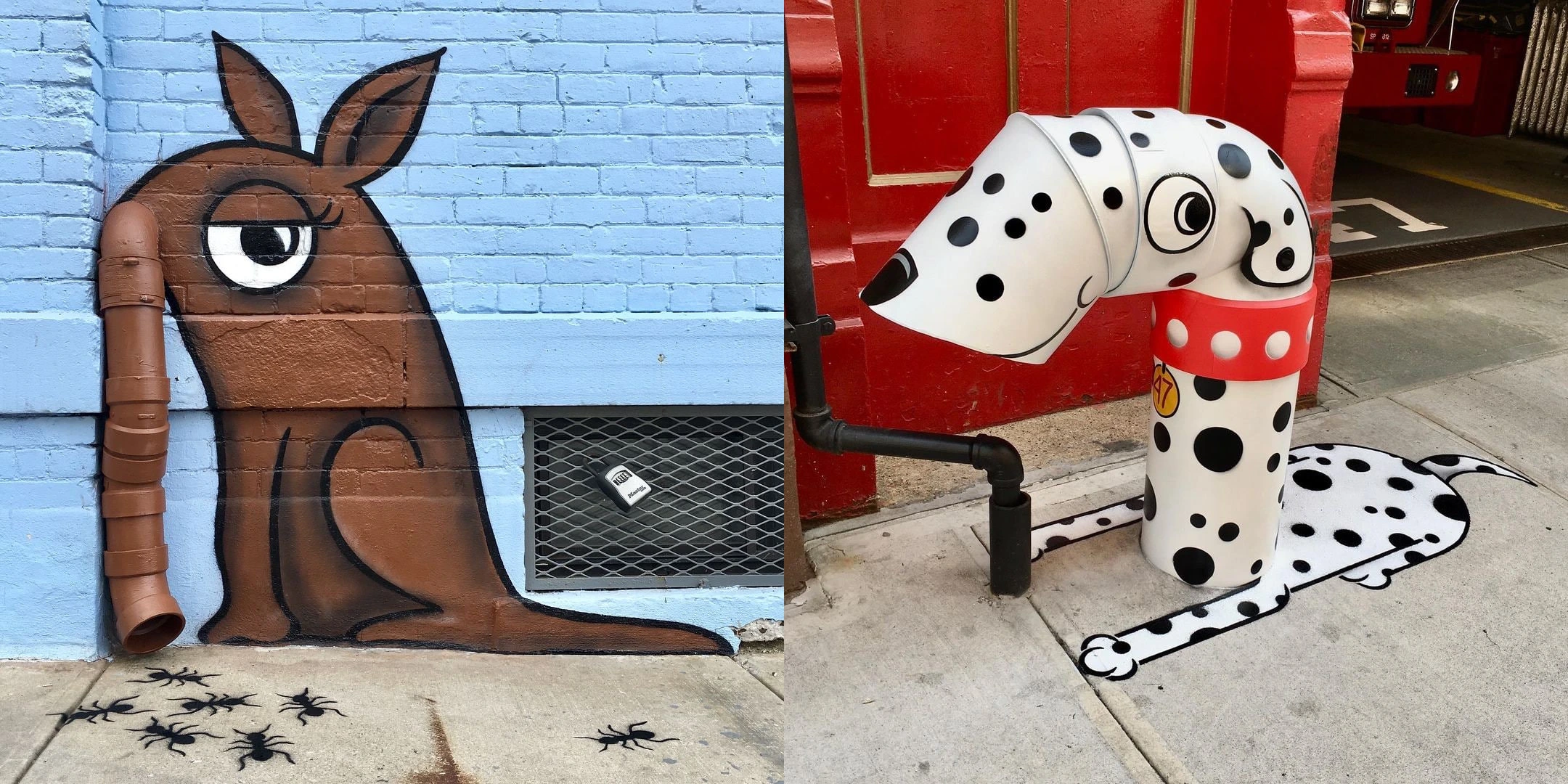
In the pair below, a narrow pipe suggests an anteater’s long nose, while a broad curved duct becomes a Dalmatian’s head. The original material does not need to disappear. Recognizing it is part of the pleasure.
A playful result, a practical process
In an interview with Bored Panda, Tom Bob described starting with sketches, measuring the object and preparing stencils. Sometimes a shape suggests its character immediately; sometimes the idea takes longer. During lockdown, he also explored cities through Google Street View, collecting ideas for possible future pieces.
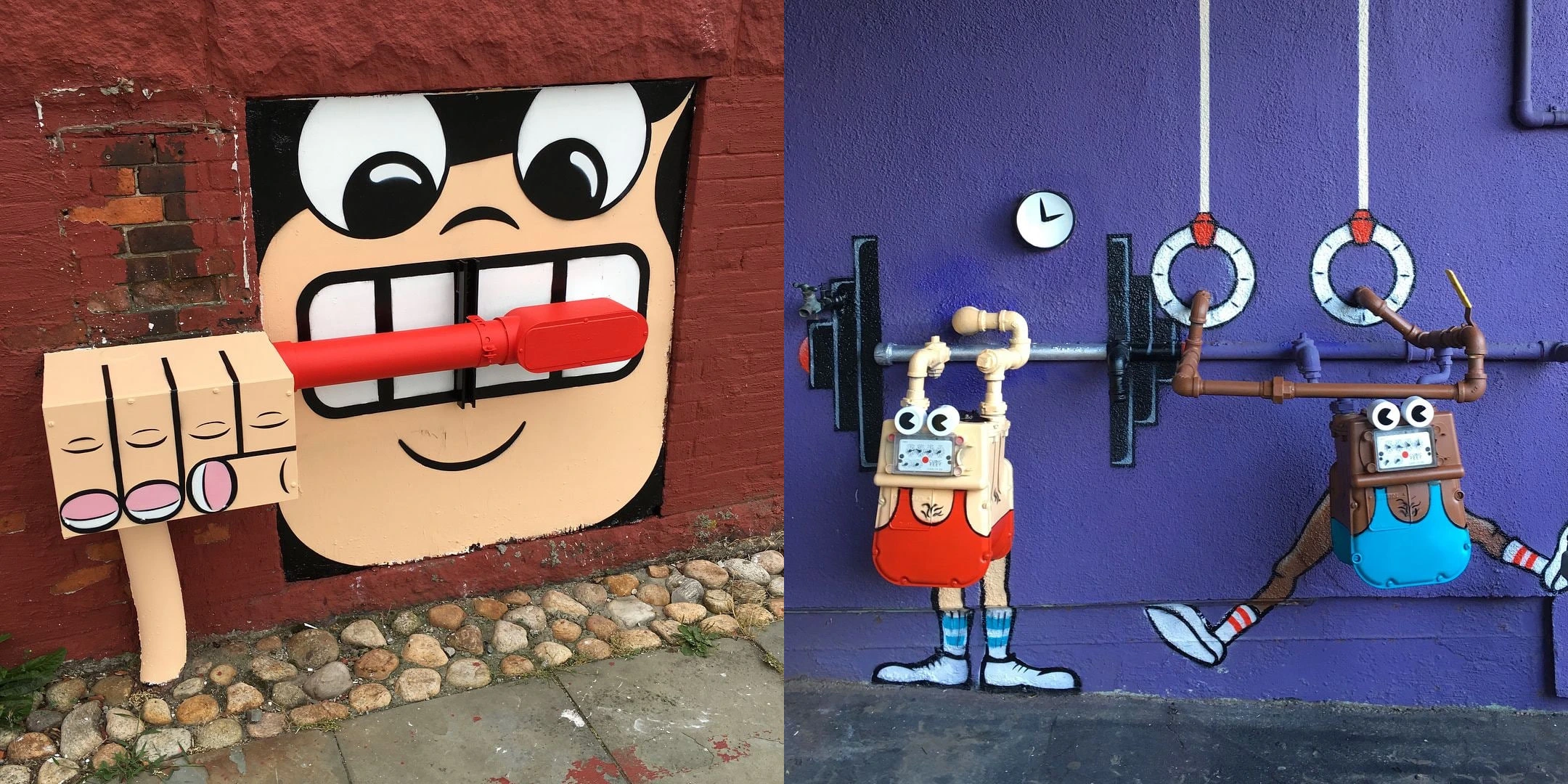
That preparation helps explain the precise meeting points between paint and hardware. A red pipe becomes a toothbrush; the branches of another installation become athletes’ arms. Strong outlines and simple expressions let the scene make sense to someone passing by, without a lengthy explanation.
Beyond New York
His work is often associated with New York, but its geography extends further. Art Valais records projects across U.S. cities as well as Dubai and Taiwan. In Vétroz, Switzerland, his Let’s play project for the open-air museum turns familiar urban objects into a playful route through the town.
A good idea is not the only condition for making a piece, however. In the interview, the artist discussed permission and the different attitudes cities have toward street art. These are interventions in an actual shared environment, rather than images that can be produced independently in a studio.
A design lesson in noticing
The most compelling transformation happens in how we read a shape. A familiar silhouette acquires a new context and becomes a character. Designers can recognize the same principle in visual metaphors, packaging and identity: instead of adding decoration, find an idea inside the existing constraint.
Tom Bob leaves the viewer a small discovery. First we see the character, then notice the pipe or meter and mentally assemble the joke. That second moment is what makes these works memorable.
Sources: artist interview, Art Valais, Let’s play project.

No comments yet. Start the conversation.