
Shupliak graduated from the architecture faculty of Lviv Polytechnic in 1991. He says he began his Dvovzory series that same year. These double images became a distinctive part of his practice, which also includes landscapes, still lifes and abstraction. On his English-language website, the series appears under the title Hidden images.
How One Painting Holds Two Images
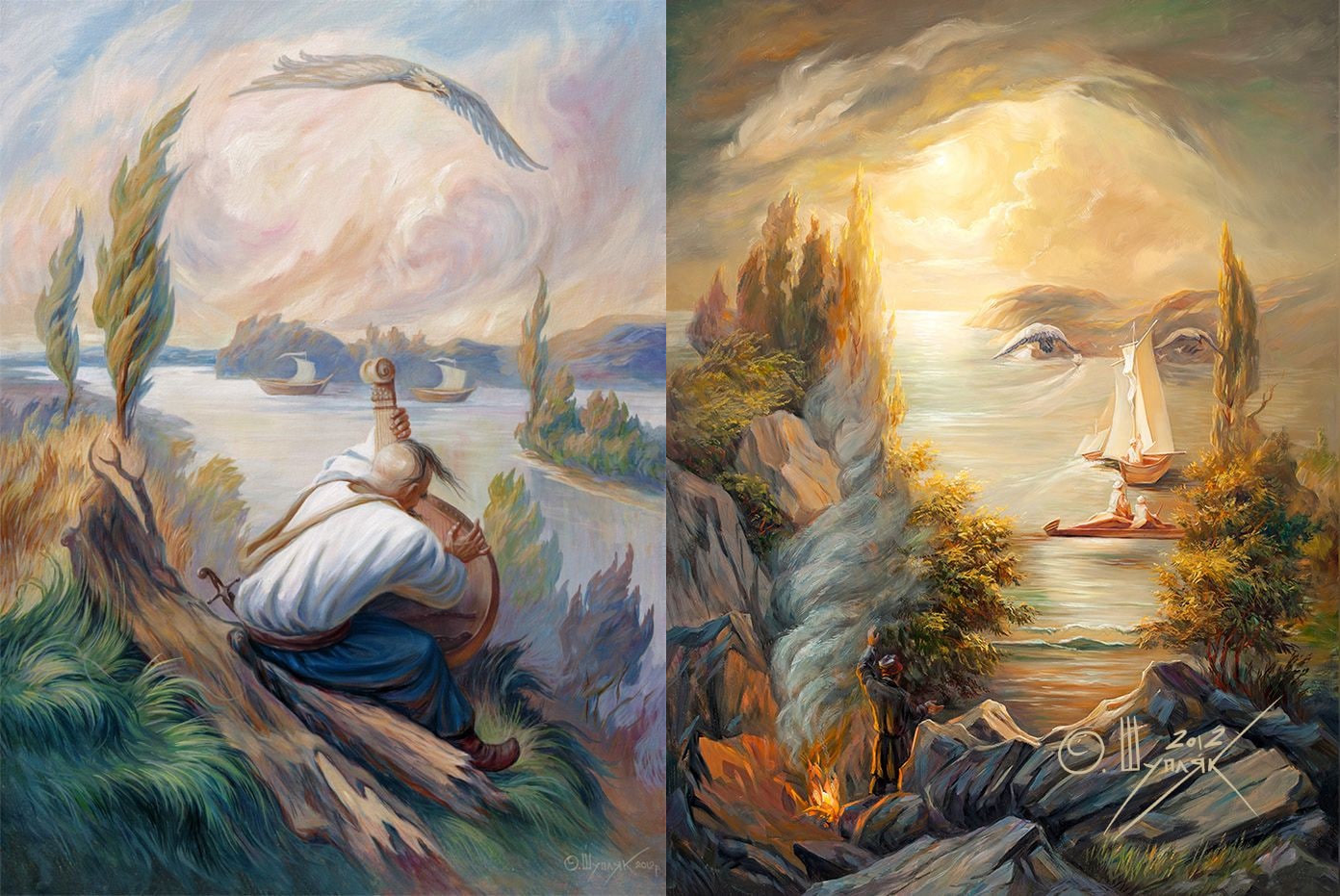
You can follow the action within each scene or focus on its broad shapes and outlines. Roofs become eyelids, dark windows turn into pupils, and a curve of shoreline describes a cheek. The objects stay in place but change roles as your attention shifts. The most rewarding areas are often those where a single line belongs to two different forms.
Spirit of Freedom and Aivazovsky, the two paintings on the cover, make this approach particularly clear. On the left, boats on the water become the eyes of a large face, while the musician and his instrument build its centre. On the right, a sailing boat, distant shorelines and pale bands of water also begin to suggest human features. In both works, stepping back from individual details reveals the composition at another scale.
Shupliak connects this way of building an image with his architectural education. In an interview with Uriadovyi Kurier, he explained that each element serves both an aesthetic and a structural purpose. Remove a cottage or move a boat, and you change the landscape and the portrait at once. Placement matters as much as colour or brushwork.
Portraits You Can Read Piece by Piece
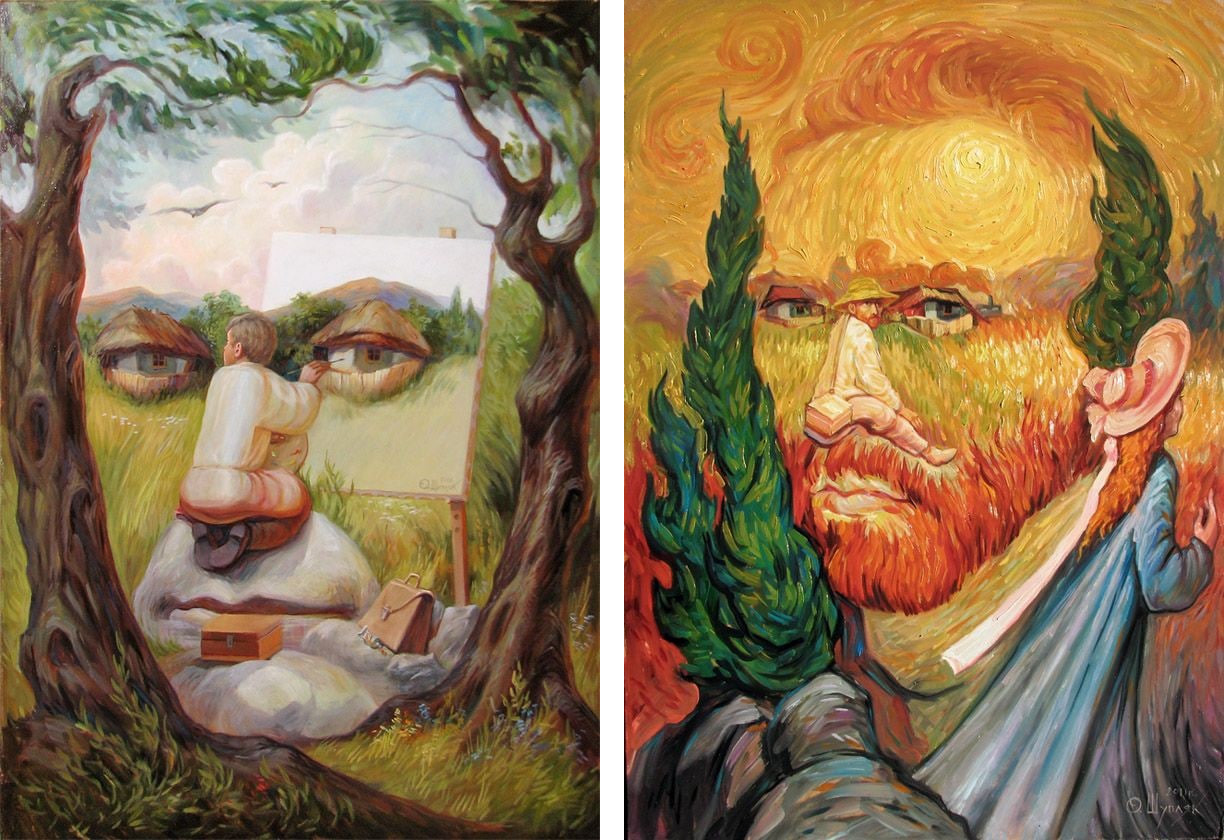
The pair below shares a particularly effective motif: a small human figure within a rural scene. On the left, in Self-Portrait Under the Linden Trees, a boy at an easel forms part of a large face, with two cottages occupying the position of its eyes. Trees frame the composition and rocks build the lower face. You can begin with the boy and gradually discover the portrait, or make the same journey in reverse.
On the right, Double Portrait of Van Gogh gives the same approach a different painterly character. Yellow and orange strokes connect the sky, field and red hair; dark cypresses establish strong verticals. A small figure in a hat becomes part of the larger portrait’s nose. Recognition comes through the features, the palette and the movement of the brushwork. There is still plenty to examine after the first reveal.
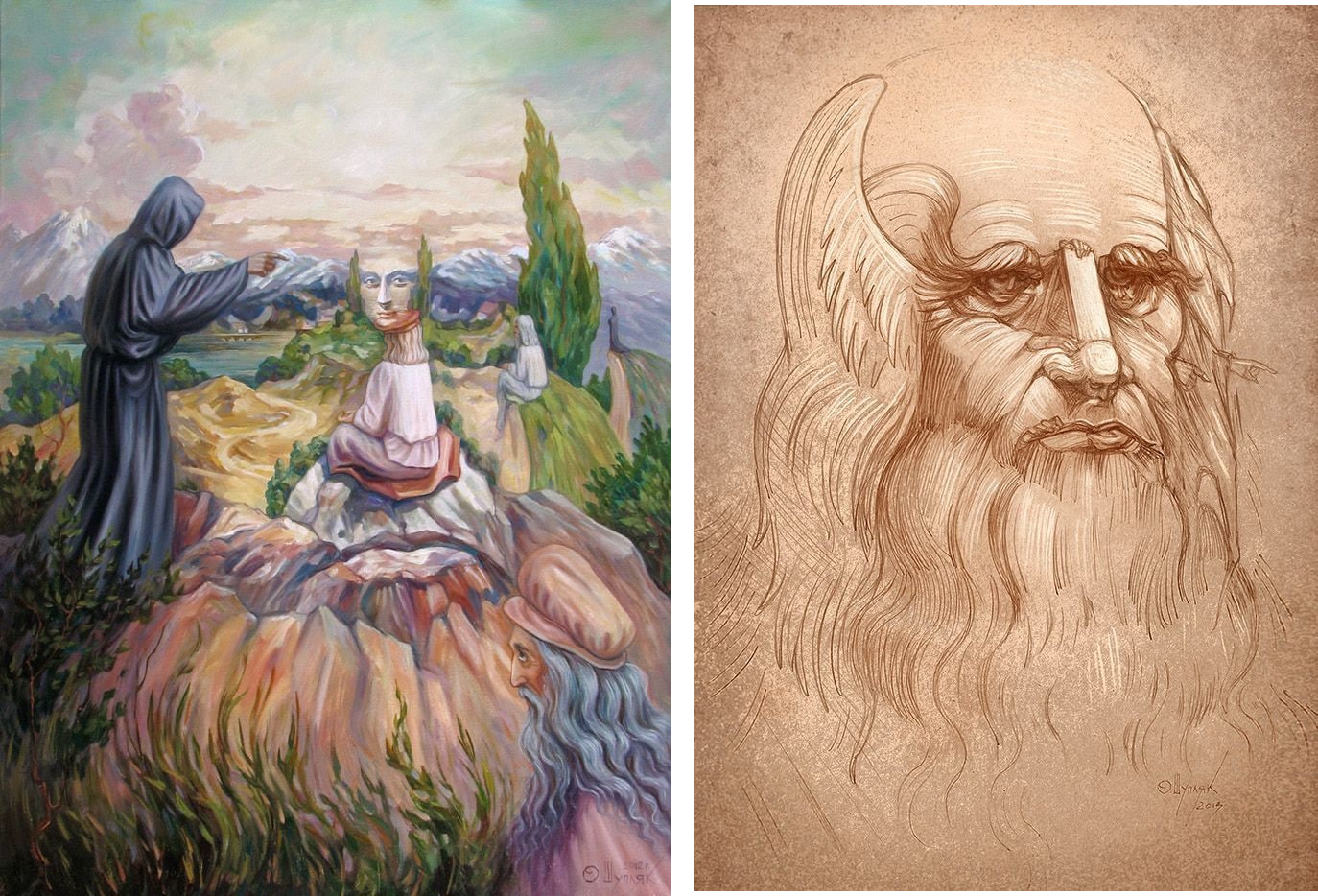
In Visions in the Mountains, a face emerges from a rocky slope, trees and figures. The central figure recalls the Mona Lisa, while another profile appears at the lower right. The drawing beside it, Painter, offers a similar transformation with very little colour: the outlines of wings and a small figure become part of a bearded face. Seen together, the works reveal how much the lines alone can do.
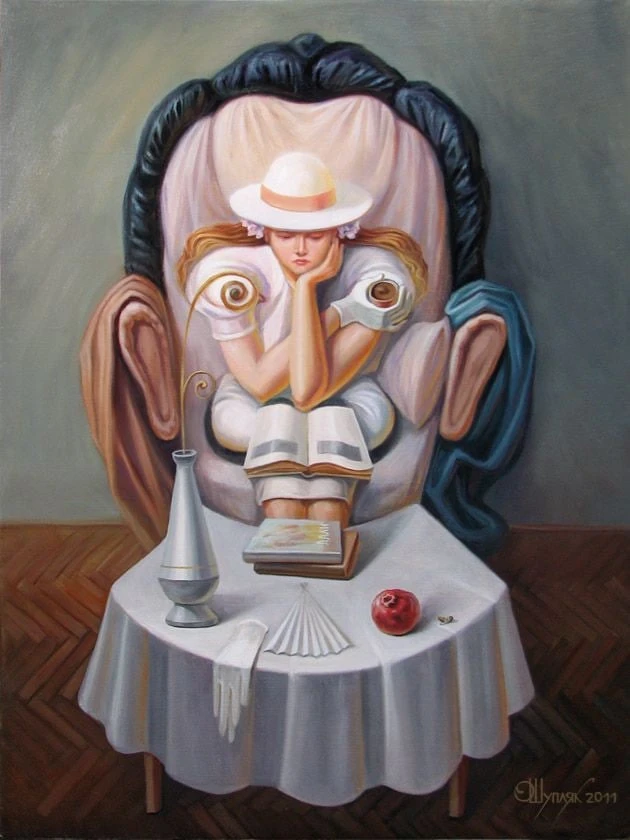
In Girl Reading Dali, painted in 2011, the setting moves indoors. A young woman sits at a round table with a book, while the entire scene forms a portrait of Salvador Dalí. Curls beside her shoulders become eyes, her arms shape the nose, and the open book defines the line of the moustache. Still-life objects and folds of fabric sustain both readings, drawing the eye back and forth between the face and the reading scene.
What Remains After the Reveal
In an interview published by Lviv Polytechnic, Shupliak explained that a double image begins with an idea, followed by a lengthy process of fitting the details together. Looking at it can become a sequence too: first recognition, then an investigation of how the image works. Before moving on, choose a single fragment and follow both of its roles.
Cottages, fields, trees and the imagery of the kobzar, the Ukrainian bard, give these compositions a particular cultural character. Shupliak has emphasised the importance of national roots in his work. In the paintings shown here, that connection can be felt in the way the image is organised: a person is literally composed of surroundings, everyday objects and familiar landscapes.
For anyone working in visual communication, these paintings offer a close study in composition. A small detail needs to make sense up close, while the larger silhouette must hold together as a whole. Try viewing an image at a smaller size, then return to its details. Which elements keep both scenes intact? More works can be explored in Oleg Shupliak’s official gallery.
Sources: Lviv Polytechnic: Шупляк Олег · Урядовий кур’єр: інтерв’ю з Олегом Шупляком, 1 жовтня 2022 · Lviv Polytechnic: Олег Шупляк: мистецтвом треба дивувати світ, 19 жовтня 2017 · Oleg Shupliak: Hidden images
No comments yet. Start the conversation.